Your Day Doesn’t Begin When You Wake Up — It Begins the Night Before
Most productivity advice is obsessed with the morning routine. Cold showers, journaling, meditation, a 5 AM alarm — the cultural mythology around winning your morning is relentless. But here’s what the research and the highest performers actually understand: your morning is nothing more than a reflection of how well you engineered your evening routine the night before. The decisions you make between 6 PM and 10 PM are the ones that determine whether you wake up sharp, focused, and ready to execute deep work — or groggy, reactive, and running on caffeine just to function like a human. This isn’t philosophy. It’s biology. Your circadian rhythm, cortisol cycle, adenosine clearance, and sleep architecture are all governed by inputs you control before you ever close your eyes. Miss the night before, and no alarm clock, no cold plunge, and no green juice will save your morning.
Why Your Evening Routine Is the Lever Most High Performers Pull First
Most high performers invest heavily in their evening routine because it directly programs the quality of sleep, which in turn controls cognitive function, emotional regulation, and physical recovery. A structured, intentional night-before protocol is the single highest-leverage behavioral system available to ambitious professionals looking to maximize output without burning out.
The cultural obsession with “winning the morning” has things precisely backwards. You cannot willpower yourself into a high-output morning if your physiology spent the night in a state of cortisol elevation, fragmented sleep staging, and inadequate REM cycling. Jeff Bezos has publicly stated that he prioritizes eight hours of sleep because he views it as the foundation of better thinking and decision-making. Arianna Huffington, after literally collapsing from exhaustion, built an entire company — Thrive Global — around the core premise that sleep is the non-negotiable engine of high performance, not a luxury to be traded for productivity theater.
According to the CDC, more than one-third of American adults regularly fail to get the recommended seven or more hours of sleep per night. The downstream effects compound rapidly: impaired memory consolidation, weakened immune function, elevated cortisol, and decision-making that sleep researchers have compared to legal intoxication after just 17 to 19 consecutive hours of wakefulness. The fix is not a smarter alarm or a better supplement stack. It is a disciplined, intentional protocol that begins at sundown.
Key Takeaway: Your evening routine is not a wellness indulgence — it is a high-performance system. What you do in the three hours before sleep is the primary variable determining the cognitive and physical resources available to you the next day.
The Sleep Science That Actually Makes or Breaks Tomorrow
Sleep is not a passive idle state — it is an active biological process of cellular repair, hormonal regulation, and memory consolidation. The quality of that process is almost entirely determined by what happens in the two to four hours before sleep onset, making pre-sleep behavior the highest-leverage variable in any serious performance optimization strategy.
Understanding Sleep Architecture
Sleep progresses through 90-minute cycles, each containing light sleep, slow-wave (deep) sleep, and REM sleep. Slow-wave sleep dominates the early cycles and handles physical restoration — muscle repair, growth hormone secretion, and immune recalibration. REM sleep, critical for emotional processing and memory consolidation, dominates the latter half of the night. Cut your sleep short by even 90 minutes, and you disproportionately eliminate REM sleep, gutting cognitive performance and emotional regulation for the entire following day. A landmark study published in Current Biology confirmed that irregular sleep timing — even when total sleep hours remained constant — was associated with measurably lower academic performance and disrupted circadian rhythms in participants.
Circadian Rhythm and Melatonin Timing
Your circadian rhythm is a 24-hour internal clock governed by light, ambient temperature, and feeding cues. Melatonin — the hormone that signals darkness and initiates the cascade toward sleep — begins rising approximately two hours before your natural sleep time. Critically, blue light exposure in the evening hours can suppress melatonin production by up to 85%, according to researchers at Harvard Medical School. This does not merely delay sleep onset; it actively degrades sleep architecture by pushing back your circadian phase, reducing time spent in the deepest, most restorative sleep stages.
Key Takeaway: Sleep quality is determined upstream — by what you do before bed. Melatonin suppression from screens and poor light hygiene is one of the most measurable, and most reversible, causes of chronic underperformance.
Engineering Your Evening Routine: The Hour-by-Hour Protocol
An effective evening routine is a structured, time-anchored sequence of behavioral changes that begins at least three hours before sleep. It systematically removes the biological and psychological barriers to deep, restorative sleep by addressing nutrition timing, light exposure, mental stimulation, and environmental conditions in a deliberate sequence.
Three Hours Before Bed: The Nutrition and Exercise Cutoff
Stop eating at least two to three hours before your target sleep time. Late-night eating elevates core body temperature and forces the digestive system into active processing mode — both of which directly compete with sleep onset and deep sleep quality. Your body must redirect metabolic energy toward cellular repair, not digestion. The same logic applies to intense exercise: high-intensity training within two to three hours of bedtime raises core temperature and cortisol, two powerful sleep antagonists. Morning and early afternoon training windows are consistently associated with superior sleep quality in the research literature.
Alcohol deserves special attention here because it is among the most insidious evening traps. While it may accelerate sleep onset, a study published in JMIR Mental Health found that alcohol consumption reduces overall sleep quality by approximately 24% and significantly suppresses REM sleep — meaning you spend eight hours in bed and wake up feeling as though you slept for five.
Two Hours Before Bed: The Digital Sunset
At the two-hour mark, begin what sleep researchers call a digital sunset. Power down or fully dim all screens. If device use is unavoidable, enable maximum warm-tone display settings and reduce brightness to the floor. The biological objective is straightforward: stop suppressing melatonin and allow the neurological cascade toward sleep to begin unimpeded. Replace screen time with low-arousal alternatives — reading physical books, light stretching, unhurried conversation, or journaling.
A 2018 study from Baylor University found that writing a detailed to-do list for the following day — a practice called cognitive offloading — helped participants fall asleep an average of nine minutes faster than those who journaled about tasks they had already completed. That is a passive, compounding return on five minutes of effort.
One Hour Before Bed: Environmental Design
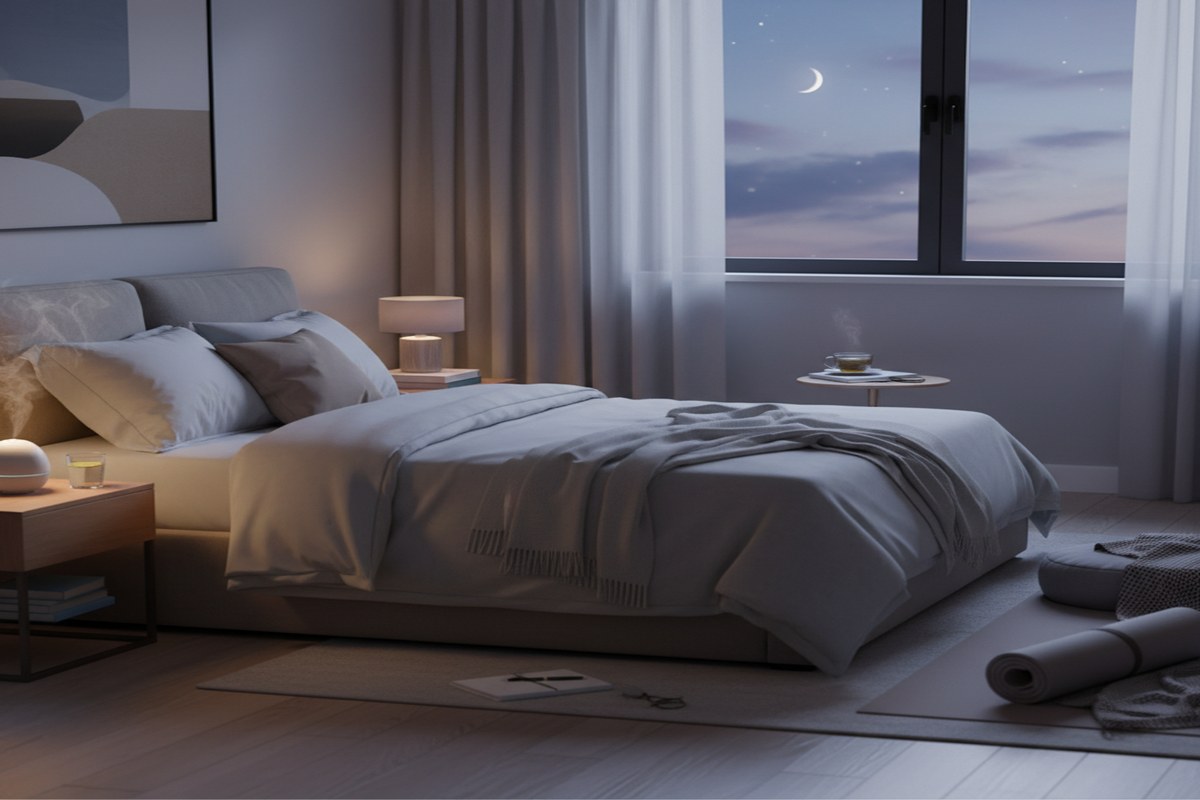
Sleep is a physiological event, and the environment must signal safety and darkness to your nervous system. Your core body temperature needs to drop by one to three degrees Fahrenheit to initiate and sustain deep sleep. Set your bedroom thermostat to between 65 and 68°F (18–20°C) — the range consistently cited as optimal across peer-reviewed sleep research. Eliminate light entirely; even low-level ambient light through closed eyelids has been shown to disrupt sleep staging and suppress melatonin. Blackout curtains or a quality sleep mask are high-ROI tools, not luxury items.
Key Takeaway: The evening routine is a layered, time-sequenced protocol — not a single habit. Each behavioral input in the three hours before bed compounds to either protect or degrade your sleep architecture, and therefore your next-day output.
Cognitive Priming: How to Set Up Tomorrow While You Sleep
Cognitive priming before bed involves deliberately preparing the brain to process and consolidate tomorrow’s priorities during sleep. Practices like structured journaling and task-list preparation allow the brain’s default mode network to work on problems overnight, often arriving at clearer thinking and better decisions by morning.
This is where the “night before” concept becomes genuinely powerful beyond just sleep hygiene. Sleep is not passive maintenance — it is active processing. During REM sleep, the brain replays the day’s learning, makes novel associative connections across domains, and structures narrative memory. By intentionally reviewing your priorities before sleep, you are feeding the brain a work brief for its overnight processing cycle. You are not just winding down; you are queuing tomorrow’s cognitive output.
High performers including Tim Ferriss and Ryan Holiday have both discussed structured evening journaling not as an emotional outlet but as a deliberate intellectual practice: reviewing what broke down, what accelerated progress, and what requires a decision tomorrow. This combines the Baylor University cognitive offloading data with the well-established benefits of reflective journaling for reducing rumination — a leading cause of sleep-onset insomnia in high-achieving professionals who struggle to disengage from work mode.
Key Takeaway: Evening journaling and next-day task preparation are not soft wellness habits. They are cognitive priming tools that leverage sleep’s neurological consolidation function to directly increase next-morning clarity, creative output, and decision quality.
Using Wearables to Measure What Your Evening Routine Is Actually Doing
Wearable devices like the Oura Ring, WHOOP strap, and Apple Watch Ultra provide objective nightly data on sleep stages, heart rate variability, resting heart rate, and recovery scores — making the abstract impact of your evening routine concrete, measurable, and actionable through a personal feedback loop.
Heart rate variability, or HRV — the variation in milliseconds between consecutive heartbeats — is one of the most sensitive biomarkers for physiological recovery and autonomic nervous system balance. A high HRV reading generally indicates strong recovery and readiness for high-intensity cognitive or physical output. A depressed HRV signals that the body is under stress, processing inflammation, or inadequately recovered from the previous day. WHOOP’s internal dataset, spanning millions of recorded nights, found that alcohol consumption is among the single greatest suppressors of recovery scores, often knocking HRV down by 15 to 30% the morning after even moderate consumption.
Tracking HRV nightly over several weeks while systematically adjusting your evening routine variables — meal timing, alcohol, screen exposure, room temperature — lets you run personal n=1 experiments with real biological data. Within two to four weeks of consistent tracking, most users identify two or three specific evening behaviors that are measurably and repeatably destroying their sleep quality and next-day readiness.
Key Takeaway: Wearables transform sleep optimization from an abstract discipline into a data-driven feedback loop. The Oura Readiness Score and WHOOP Recovery Score are not vanity metrics — they are the most actionable daily KPIs most professionals are not yet tracking.
The Biggest Evening Routine Mistakes That Are Killing Your Next Day
The most common evening routine mistakes that degrade sleep quality and next-day performance are inconsistent sleep timing, late-night eating, alcohol consumption, screen exposure within two hours of bed, and mentally activating work that keeps the prefrontal cortex running hot too close to sleep onset.
- Inconsistent bedtimes: Even weekend “sleep debt recovery” shifts your circadian phase and creates a documented phenomenon researchers call social jet lag. A study published in the Journal of Clinical Sleep Medicine linked irregular sleep schedules to higher rates of obesity, cardiovascular disease, and mood disorders — independent of total sleep duration.
- Doom-scrolling in bed: The bedroom must become psychologically associated with sleep and intimacy — not stimulation and cortisol. Every minute of social media in bed is conditioning your nervous system to treat your sleep environment as an alert zone.
- Caffeine timing: Caffeine carries a half-life of five to seven hours. A 3 PM coffee means 50% of that caffeine is still bioactive at 8 to 10 PM, measurably reducing slow-wave sleep even when you fall asleep without difficulty.
- Working until bedtime: High-stakes cognitive or emotionally demanding work elevates cortisol and sustains prefrontal cortex activation — the worst possible physiological state for sleep onset. Build a hard stop at least 90 minutes before bed for anything requiring focused mental effort.
Key Takeaway: The vast majority of chronic sleep problems experienced by ambitious professionals are not clinical insomnia disorders — they are the predictable, measurable consequences of specific, fixable behaviors repeated every evening.
Frequently Asked Questions About Building an Effective Evening Routine
How long should an evening routine actually be?
An effective evening routine spans approximately two to three hours before your target sleep time. This is not three hours of rigid rituals — it is a window during which you progressively reduce stimulation, light exposure, food intake, and cognitive load. Even implementing a 60-minute wind-down window produces measurable improvements in sleep onset speed and deep sleep duration.
How many hours before bed should I stop eating?
Aim to finish your last substantial meal two to three hours before sleep. Late-night eating elevates core body temperature and metabolic activity, both of which conflict with sleep architecture. A light, low-glycemic snack if genuinely hungry is less disruptive than a full meal, but the general principle is to enter sleep with digestion largely complete.
Can I exercise at night without hurting my sleep?
High-intensity training within two to three hours of bedtime tends to raise cortisol and core temperature, delaying sleep onset. However, light activity — a 20-minute evening walk, yoga, or mobility work — is not only benign but often beneficial, as it reduces stress hormones and can improve sleep onset. The problem is intensity and timing, not exercise itself.
What is the single most impactful change I can make to my evening routine right now?
Set a consistent bedtime — and protect it like a meeting with your most important client. Circadian consistency is the foundational layer beneath every other sleep optimization tactic. No supplement, device, or protocol delivers meaningful results on top of an irregular sleep schedule. Lock in a bedtime, hold it within a 30-minute window seven days a week, and track the change in your morning energy over two weeks.
Build the Night Before, Win the Day After
The highest-leverage performance intervention available to you right now is not a new productivity app, a better task manager, or a sharper morning routine. It is your evening routine — the three hours before sleep that most ambitious professionals treat as downtime but that the best performers engineer with the same intentionality they bring to their most important work.
By treating the night before as a strategic window — controlling light exposure, nutrition timing, cognitive stimulation, and sleep environment — you directly program the neurological and physiological conditions that determine next-day excellence. Sleep is not a passive recovery mechanism. It is the biological substrate on which every other layer of your success stack runs. Neglect it, and the entire architecture weakens. Optimize it, and everything else — focus, decision-making, energy, creativity — compounds upward.
Start with one variable. Pick your bedtime, your screen cutoff, or your bedroom temperature. Hold it consistent for 14 days. Track your focus, mood, and energy each morning with a simple one-to-ten score. The data will make the case better than any productivity guru ever could.
Your stack doesn’t start with capital, code, or calendars. It starts with sleep. And sleep starts the night before.
Disclaimer: This content is for informational purposes only and does not constitute medical advice, diagnosis, or treatment. Always consult with a qualified healthcare professional before making any health-related decisions.
You might also enjoy: How To Build A Better Brain: A Neuroscientist’s Take On Ketamine, Nicotine & Cognitive Optimization
You might also enjoy: The Best Peptide & Supplement Stack for Hair Growth, Smart Drugs for an Aging Brain & Aging Anxiety
You might also enjoy: Are “Poop Pills” the Ultimate Gut Biohack? The Science of Fecal Microbiota Transplants