
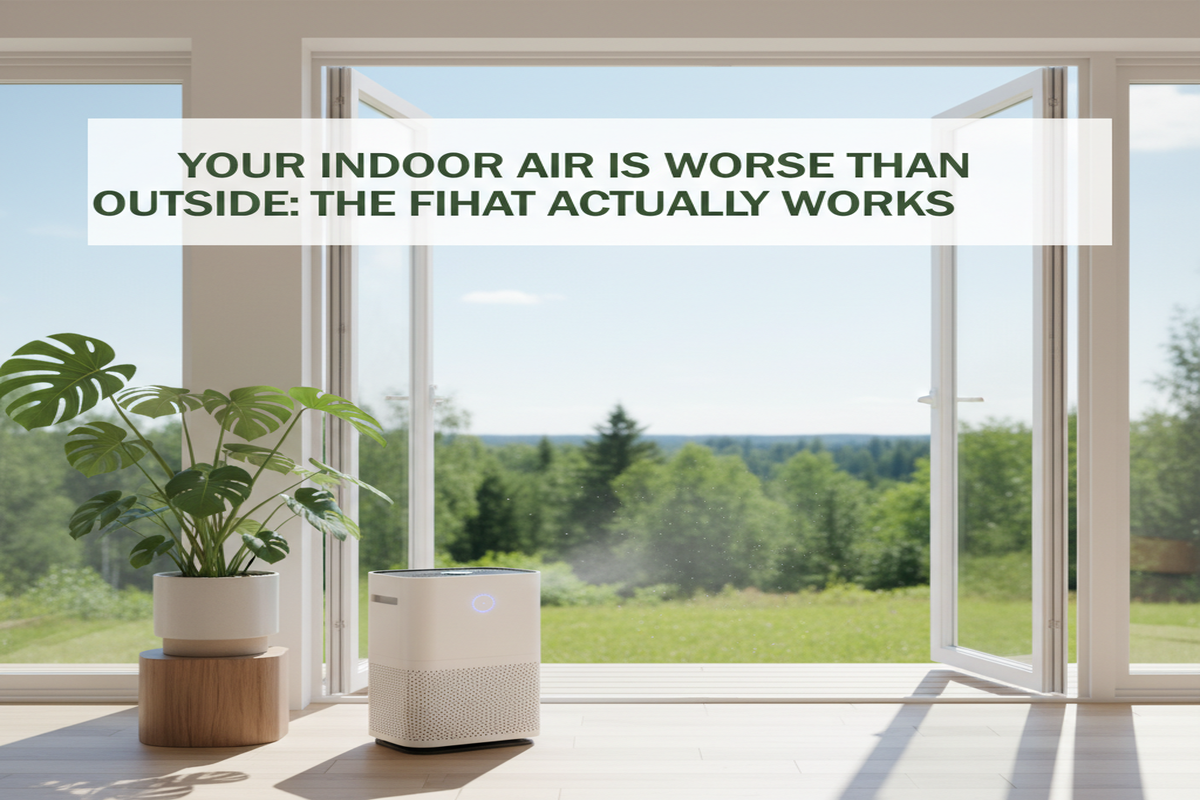
Your Indoor Air Is Probably Worse Than Outside — Here’s How to Fix It
Here’s a stat that should stop you cold. The EPA estimates that indoor air quality can be two to five times more polluted than outdoor air. You read that right. The air inside your home or office — the air you breathe for roughly 90% of your day — is likely dirtier than the smoggy city street outside your window. If you’re stacking habits for peak performance and long-term health, ignoring your air is one of the biggest blind spots you can have.
This isn’t paranoia. It’s data. The same precision you apply to sleep, nutrition, or HRV tracking needs to extend to what you breathe. Let’s break down what’s happening, why it matters, and exactly what you can do about it today.
Why Indoor Air Quality Is Often Worse Than Outdoor Air
Indoor spaces trap pollutants that outdoor environments disperse. Outside, wind and rain break down contaminants. Inside, your home recirculates the same air — concentrating everything in it. Modern buildings are built tight for energy efficiency. That’s great for your heating bill. It’s terrible for air exchange.
According to the U.S. Environmental Protection Agency, Americans spend approximately 90% of their time indoors. In those enclosed spaces, pollutant concentrations can build to levels two to five times higher than outdoors. For high performers optimizing every input, that’s a massive variable going completely unmanaged.
Think of it this way: you wouldn’t train in a gym filled with exhaust fumes. But you might be sleeping, working, and eating in air that’s functionally doing the same thing. The damage is slow, cumulative, and invisible — which is exactly what makes it so dangerous.
Key Takeaway: Indoor air quality is a measurable health input, just like diet and sleep. Modern buildings trap pollutants at concentrations that often far exceed outdoor air. If you’re not monitoring it, you’re flying blind.
The Hidden Pollutants Living in Your Home Right Now
Your home is full of invisible chemical and biological threats. Most people never think about them. Here are the main ones you need to know — and where they’re hiding.
Volatile Organic Compounds (VOCs)
VOCs are gases released from common household products. Paint, cleaning sprays, new furniture, air fresheners, and flooring all off-gas VOCs constantly. Benzene, formaldehyde, and toluene are the heavy hitters. The World Health Organization classifies both benzene and formaldehyde as known human carcinogens.
New furniture and flooring are the worst offenders. A brand-new couch or hardwood floor can off-gas for months to years after installation. That “new smell”? That’s chemicals. Welcoming it into your bedroom without ventilation is a mistake.
Fine Particulate Matter (PM2.5)
PM2.5 refers to particles smaller than 2.5 microns in diameter. They’re so small they bypass your nose and throat entirely — going straight into your lungs and bloodstream. Research published in The Lancet links long-term PM2.5 exposure to cardiovascular disease, cognitive decline, and premature death.
Sources include cooking smoke, candles, incense, and even your toaster. Gas stoves are a significant PM2.5 source. Studies have found that cooking a single meal on a gas stove can spike indoor PM2.5 to levels that exceed EPA outdoor air quality standards. That’s a daily event in most households.
Biological Pollutants
Mold spores, dust mites, pet dander, and bacteria fall into this category. They’re especially harmful for people with allergies or asthma. But they also drive low-grade inflammation in everyone — the kind of slow-burn immune activation now linked to brain fog, metabolic dysfunction, and accelerated aging. You don’t need a diagnosed allergy to feel the effects.
Carbon Dioxide (CO2)
CO2 isn’t a toxin at normal levels — but high concentrations hurt your brain. Research from Harvard’s T.H. Chan School of Public Health found that cognitive performance drops measurably when CO2 levels exceed 1,000 parts per million (ppm). In a sealed office or bedroom, levels can easily hit 1,500–2,000 ppm within a few hours. That’s your focus quietly being killed while you try to do deep work.
Key Takeaway: The four main indoor threats — VOCs, PM2.5, biological particles, and CO2 — each degrade either your long-term health or your daily performance. Most people have never measured any of them.
How Poor Indoor Air Quality Silently Wrecks Your Performance
You won’t feel acutely sick from bad indoor air. That’s what makes it so insidious. The damage is cumulative, and the symptoms are easy to misattribute. Here’s how it shows up in your daily output.
Brain Fog and Focus Loss
High CO2 and VOC levels directly impair prefrontal cortex function. That’s your executive decision-making center — the part of your brain you need for deep work, strategy, and complex problem-solving. A study in Environmental Health Perspectives found that doubling CO2 concentrations cut strategic thinking scores by roughly 50%. That’s half your cognitive capacity, gone — just from the air in your office.
Degraded Sleep Quality
Bedroom air quality matters more than most people realize. High CO2 from a closed bedroom builds overnight. Studies show elevated CO2 increases arousal events during sleep — meaning you wake up partially without remembering it. The result is unrefreshing sleep and suppressed recovery. You might log eight hours. But the quality was gutted because you were breathing recycled air all night.
Systemic Inflammation
PM2.5 particles that enter the bloodstream trigger a continuous immune response. Your body treats them as invaders. Over time, this chronic activation raises inflammatory markers like CRP and IL-6 — the same biomarkers linked to heart disease, cancer, and neurodegeneration. You can eat clean and train hard. But if you’re breathing polluted air around the clock, you’re fighting an uphill battle you didn’t sign up for.
Key Takeaway: Poor indoor air quality is a hidden performance killer. It cuts cognitive output, degrades sleep quality, and drives chronic inflammation — all without obvious immediate symptoms. Fix the air, and you remove a significant drag on your entire health stack.
How to Measure Your Indoor Air Quality (Don’t Skip This Step)
You can’t manage what you don’t measure. This is the first principle of biohacking, and it applies directly to your air. The good news: measuring your air has never been cheaper or easier.
Consumer Air Quality Monitors
Consumer-grade monitors now track PM2.5, VOCs, CO2, temperature, and humidity — all in real time. Devices like the Airthings Wave Plus, the IQAir AirVisual Pro, or the Awair Element sit on your desk or nightstand and give you a live read of what you’re breathing.
The goal is to find your problem zones. You might discover your bedroom CO2 spikes overnight. Your kitchen might hit dangerous PM2.5 levels every time you cook. You won’t know without measuring. Pick one monitor, run it for a week, and let the data guide your fixes. It’s the same approach you’d take with any other biometric.
Radon Testing
Radon is a radioactive gas that seeps up from soil and rock. It’s odorless, colorless, and deadly. The EPA estimates radon causes around 21,000 lung cancer deaths per year in the U.S., making it the second leading cause of lung cancer after smoking. A basic radon test kit costs under $20. That’s one of the highest-ROI health checks you can do. If your levels are high, a mitigation system can reduce them by up to 99%.
Key Takeaway: Baseline testing is non-negotiable. A week of monitor data shows exactly where your exposure problems are. Radon testing is a cheap, one-time action with massive long-term health upside.
The Best Tools to Improve Your Indoor Air Quality Fast
Once you know your problem areas, the fixes are straightforward. Here’s what actually works — ranked by impact per dollar spent.
HEPA Air Purifiers
HEPA filters are the gold standard for removing PM2.5, dust, pollen, mold spores, and pet dander. A true HEPA filter captures 99.97% of particles at 0.3 microns. Put one in your bedroom and one in your main workspace. Those are your two highest-exposure rooms by far.
For bedrooms, look for models with a low-noise mode (under 35 dB) so it runs all night without waking you. Brands like Coway, Winix, and Levoit offer strong performance at sub-$200 price points. Check the CADR (Clean Air Delivery Rate) rating against your room’s square footage before buying.
Kitchen Ventilation
Cooking is one of the biggest indoor air quality hazards — and one most people completely ignore. Gas stoves emit nitrogen dioxide (NO2) and carbon monoxide. High-heat cooking releases carcinogenic compounds like acrolein and polycyclic aromatic hydrocarbons (PAHs). These are the same compounds found in cigarette smoke.
The fix is dead simple: run your range hood every single time you cook. A 2019 study found that using a range hood while cooking reduced PM2.5 exposure by over 60% compared to cooking without ventilation. That’s a free fix. It requires nothing more than flipping a switch. If you don’t have a range hood, open a window.
Daily Ventilation
Fresh air dilutes indoor pollutants. Open windows whenever outdoor air quality is good. If you live somewhere with frequent smog, check the Air Quality Index (AQI) first using the EPA’s free AirNow app. When outdoor AQI is under 100, fresh air is your friend. Aim for at least 15–30 minutes of ventilation per day. This is the simplest, cheapest lever you have.
Humidity Control
Mold needs moisture to grow. Keep indoor humidity between 40–60% and you cut off its primary resource. A basic dehumidifier or smart thermostat with humidity control handles this. High humidity also feeds dust mite populations — another common allergen and inflammatory driver. An inexpensive hygrometer can tell you where you stand in under a minute.
Eliminate High-VOC Products
Go through your cleaning products and air fresheners. Replace aerosol sprays with fragrance-free alternatives. Switch to low-VOC or zero-VOC paint when you renovate. Let new furniture off-gas in a ventilated space before bringing it indoors. These are one-time swaps that permanently lower your VOC baseline.
Key Takeaway: The three highest-impact actions are HEPA purifiers in your bedroom and office, range hood use every time you cook, and daily ventilation when outdoor AQI permits. These alone can dramatically cut your indoor pollutant exposure.
Frequently Asked Questions About Indoor Air Quality
How do I know if my indoor air quality is bad?
Common signs include persistent headaches, fatigue, brain fog, and frequent respiratory irritation that improves when you leave home. But symptoms often don’t appear until exposure is prolonged. The only reliable way to know is to measure. A consumer air quality monitor tracking PM2.5, VOCs, and CO2 will give you objective data within hours of use.
Are HEPA air purifiers actually worth it?
Yes — for PM2.5 and biological particles, HEPA air purifiers are highly effective. Independent testing by consumer groups consistently shows that well-designed HEPA units significantly reduce particle counts in real-world conditions. The key is sizing the unit correctly for your room using the CADR rating and replacing filters on schedule. A quality unit costs less than a single month of most supplement stacks.
Can houseplants improve indoor air quality?
Marginally, at best. A widely cited NASA study showed plants can absorb VOCs — but follow-up research found you’d need hundreds of plants per square meter to meaningfully improve real-world air quality. Plants are great for aesthetics and mental well-being. They don’t replace filtration. Use plants for what they’re good at. Use HEPA purifiers for actual air quality improvement.
Is cooking on a gas stove really that harmful?
The data is clear: gas stoves are a significant indoor air quality hazard. A 2022 study in the International Journal of Environmental Research and Public Health found that 12.7% of childhood asthma in the U.S. is attributable to gas stove use. NO2 and PM2.5 from gas cooking regularly spike to levels exceeding EPA outdoor air standards. Using your range hood on high every time you cook is the minimum effective response.
Your Air Is Your Foundation — Start Treating It That Way
You’re already optimizing your nutrition, your sleep, and your training. But if you’re ignoring indoor air quality, you’re leaving one of the most impactful health variables completely unmanaged. And unlike genetics or past habits, this one is almost entirely within your control.
The fix isn’t complicated. Measure first — get a monitor, run it for a week, and see what the data actually shows. Then layer in HEPA filtration in your highest-exposure rooms. Use your range hood every single time you cook. Ventilate daily when outdoor conditions allow. Control humidity. Swap out the VOC-heavy products under your sink.
These aren’t expensive changes. A solid HEPA purifier costs less than a month of supplements. A radon test costs less than dinner out. The ROI on clean air — in cognitive sharpness, sleep quality, and long-term disease prevention — is extraordinary.
Success stacks. And the cleanest, most overlooked layer of your entire health stack might just be the air you’re breathing right now. Fix it.
Disclaimer: This content is for informational purposes only and does not constitute medical advice, diagnosis, or treatment. Always consult with a qualified healthcare professional before making any health-related decisions.
You might also enjoy: What Happens to Your Body When You Sleep: The Complete Biohacker’s Guide
You might also enjoy: The Toxic Chemical Hiding in Your Kitchen (And How to Get Rid of It)
You might also enjoy: Your Weekly Biohacking Roundup: Top Health & Performance Insights You Can’t Miss