
The Hidden Health Risks of Artificial Turf You Need to Know About
Bryan Johnson—longevity entrepreneur and self-described human guinea pig—recently made a jarring discovery in his own backyard. The artificial turf he’d been living around was quietly poisoning his environment. He documented the removal on video and warned millions of followers about the artificial turf health risks most people never stop to consider. If a man who spends hundreds of thousands of dollars optimizing every health variable missed this, chances are you have too. Artificial turf looks clean, low-maintenance, and harmless. But underneath that perfect green surface lies a cocktail of toxic chemicals, heavy metals, and synthetic compounds linked to chronic inflammation, hormonal disruption, and increased cancer risk. Here’s what the science actually says.
What Is Artificial Turf Actually Made Of?
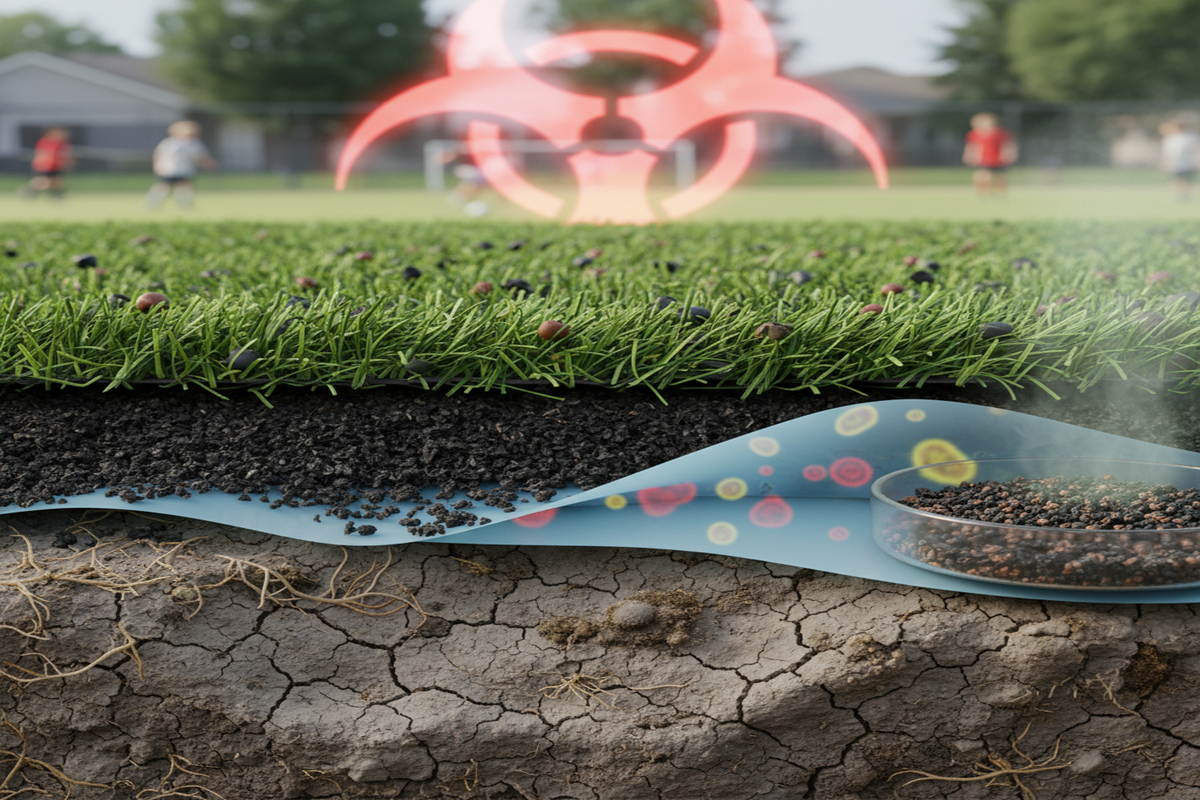
Artificial turf is not just plastic grass. It’s a multi-layer engineered system—and each layer carries its own risk profile. The visible blades are typically made from polyethylene, polypropylene, or nylon. These synthetic fibers resist UV degradation and heavy foot traffic. Below those blades sits the infill layer—the material that gives turf its cushion and bounce.
Two types of infill dominate the market:
- Crumb rubber — Shredded recycled tires. Cheap, bouncy, and widely used on athletic fields and residential lawns.
- Silica sand — A finer, granular infill often marketed as a “safer” alternative. It carries its own inhalation risks.
Crumb rubber is the bigger concern by far. Recycled tires contain over 200 chemical compounds, including known carcinogens like benzene, polycyclic aromatic hydrocarbons (PAHs), and volatile organic compounds (VOCs). These chemicals don’t stay locked inside the rubber. They leach out with heat, rain, and direct physical contact.
A 2019 joint study by the EPA and CPSC confirmed that crumb rubber infill releases measurable levels of VOCs and semi-VOCs into the surrounding environment—including the air directly above the turf surface where people breathe, play, and sit.
Key Takeaway: Artificial turf is a complex synthetic system, not a simple ground cover. The crumb rubber infill layer is the primary source of toxic chemical exposure, releasing over 200 compounds—including Group 1 carcinogens like benzene and PAHs—through heat, rain, and contact.
PFAS and Heavy Metals: The Core Artificial Turf Health Risks
PFAS—per- and polyfluoroalkyl substances—are a class of over 12,000 synthetic chemicals. They’re engineered to resist heat, water, and stains. They’re also called “forever chemicals” because they don’t break down in the environment or inside your body. They accumulate over time, silently building to toxic levels.
A 2023 study published in Environmental Science & Technology detected PFAS compounds in the synthetic fibers of artificial turf products across multiple brands. These chemicals migrate into soil and groundwater over time. They’re absorbed through skin contact and inhalation of fine dust particles.
PFAS exposure is directly linked to:
- Thyroid disease and hormonal disruption
- Immune system suppression
- Elevated LDL cholesterol levels
- Kidney and testicular cancer
- Developmental delays in children
Heavy metals are the second major threat. California’s Environmental Protection Agency found lead levels as high as 5,000 parts per million (ppm) in older artificial turf products. For context, the EPA’s hazardous waste threshold for residential soil is just 5 ppm. That’s a 1,000x overage sitting in people’s backyards.
Zinc is another heavy metal common in crumb rubber infill. When it leaches into storm drains, zinc kills aquatic life at concentrations as low as 120 micrograms per liter. It also bioaccumulates in human tissue with repeated exposure, disrupting cellular enzyme function over time.
Key Takeaway: PFAS “forever chemicals” and heavy metals like lead and zinc are present in most artificial turf systems. Lead concentrations in older turf can exceed EPA hazard thresholds by 1,000x. PFAS accumulate permanently in the body and are directly linked to cancer and immune dysfunction.
Heat Amplification: The Danger Nobody Talks About
Extreme heat is one of the most overlooked artificial turf hazards—and it dramatically worsens every other risk on this list.
On a sunny 90°F day, artificial turf surface temperatures can reach 150°F to 200°F. Natural grass under the same conditions stays around 78°F to 80°F. That’s a difference of over 100 degrees on your skin, your children’s knees, and your pets’ paws.
This extreme heat does two dangerous things. First, it accelerates off-gassing of VOCs from crumb rubber and synthetic fibers. Hotter surfaces release more chemicals into the air above them—right where people are breathing. Second, it creates direct burn risk. Studies from Penn State University documented second-degree burn cases in children who fell on artificial turf during summer months.
The heat island effect also extends beyond the turf itself. Areas surrounding artificial fields are measurably hotter than those with natural grass. In urban settings, this raises ambient temperatures and increases UV exposure for everyone nearby—even those not directly on the surface.
Key Takeaway: Artificial turf reaches temperatures 100°F higher than natural grass on hot days. Extreme heat accelerates toxic chemical off-gassing, increases airborne VOC concentrations, and creates direct burn risk—especially dangerous for children and pets who spend time at ground level.
The Cancer Connection: What the Research Shows
The cancer link is the most serious concern on this list—and it’s the one backed by the most consistent research. PAHs, a core component of crumb rubber, are classified as Group 1 carcinogens by the International Agency for Research on Cancer (IARC). Group 1 means there is sufficient evidence of cancer causation in humans. Not suspected. Confirmed.
University of Washington soccer coach Amy Griffin began tracking cancer cases among soccer players in the early 2010s. By 2015, she had documented over 200 cases of cancer—predominantly lymphoma—in athletes who regularly played on crumb rubber turf. The majority were goalkeepers, who have the most direct ground contact during matches.
A 2022 meta-analysis in Environmental Health Perspectives found a statistically significant association between crumb rubber exposure and non-Hodgkin lymphoma risk. The analysis pooled data from seven independent studies across Europe and North America, strengthening the case beyond any single study’s findings.
Children face even higher risk. They spend more time on the ground. They’re more likely to touch their faces. And their developing systems are far more sensitive to carcinogenic compounds than adult bodies. The American Academy of Pediatrics has formally called for stricter regulation of artificial turf infill materials, citing these documented cancer risks.
Key Takeaway: PAHs in crumb rubber are IARC Group 1 carcinogens. Research links artificial turf exposure to non-Hodgkin lymphoma. Children and athletes—especially goalkeepers—face the highest risk due to direct and prolonged ground contact.
Chronic Inflammation: The Slow Burn You Don’t Feel
Most artificial turf health risks don’t knock you down overnight. They operate quietly—building up over months and years of low-level daily exposure. That’s what makes them so dangerous to long-term performance and longevity.
Chronic inflammation is the root driver of most modern diseases. We’re talking cardiovascular disease, type 2 diabetes, Alzheimer’s, and autoimmune conditions. It’s not the inflammation you feel after a tough workout. It’s a persistent, low-grade immune response that slowly degrades tissue and cellular function at the molecular level.
Heavy metals like lead and cadmium are well-established triggers of this systemic inflammation. They disrupt the body’s oxidative stress response by depleting glutathione—your primary antioxidant defense system. When glutathione drops, free radical damage accumulates unchecked.
PFAS compounds amplify the problem further. Research published in JAMA Internal Medicine found that higher PFAS blood concentrations were associated with elevated C-reactive protein (CRP)—the standard clinical marker of systemic inflammation—even in individuals with no other identifiable risk factors. The chemical load itself was causing the inflammatory response.
Here’s the real problem for high performers: if you’re eating clean, training hard, and sleeping eight hours—but still feeling fatigued, foggy, or inflamed—your environment may be the variable you haven’t accounted for. The surface you sit on, the air above your lawn, the soil your kids dig in. These inputs are running 24/7.
Key Takeaway: Lead, cadmium, and PFAS from artificial turf deplete glutathione and elevate C-reactive protein—two core biomarkers of chronic systemic inflammation. Environmental toxin load can silently undermine health optimization even when all other lifestyle inputs are dialed in.
What to Do: Testing, Removal, and Safer Alternatives
The goal here isn’t panic. It’s action. If you have artificial turf at home, on your child’s school playground, or at your gym, here’s a practical, step-by-step plan.
Step 1: Test First
Don’t assume—get data. You can buy a home heavy metal test kit for around $30–$50 online. Or hire an environmental testing firm to assess lead, zinc, and PFAS levels in your turf and surrounding soil. Real numbers remove the guesswork and tell you how urgent action actually is.
Step 2: Minimize Exposure Now
If removal isn’t immediate, reduce contact:
- Remove shoes before entering your home after time on turf
- Wash hands thoroughly after any turf contact
- Avoid crumb rubber surfaces on hot days when off-gassing peaks
- Keep children and pets off crumb rubber fields whenever possible
Step 3: Plan the Removal
Crumb rubber embeds in soil and spreads easily—don’t rush this. Hire a professional crew for large areas. Wear gloves, an N95 mask, and protective clothing throughout. Dispose of infill material as controlled waste, not in a standard residential bin. Contaminated soil beneath the turf may also need remediation, depending on test results.
Step 4: Choose a Safer Replacement
Natural grass remains the gold standard. If low-maintenance is a real constraint, consider these alternatives:
- Cork or coconut husk infill — Natural, biodegradable, no known toxicity
- Organic mulch ground cover — Cost-effective and chemical-free
- Decomposed granite or gravel — Durable and inert in low-traffic zones
If you must use synthetic turf, choose products explicitly certified as PFAS-free and lead-free. The MADE SAFE certification is a reliable, independent verification standard to look for before purchasing.
Key Takeaway: Test first to quantify your risk. Minimize contact in the interim. Prioritize removal of crumb rubber infill—and replace it with natural grass or certified PFAS-free alternatives that eliminate toxic exposure at the source.
Frequently Asked Questions About Artificial Turf Health Risks
Is all artificial turf equally toxic?
No. Products using crumb rubber infill from recycled tires carry the highest risk. Newer products using cork, coconut husk, or silica sand infill have a lower toxicity profile—though silica dust still poses inhalation risks with prolonged exposure. PFAS and lead contamination vary by brand and product age, so always check for independent certifications before purchasing or installing any synthetic turf.
How do I know if my child’s school has crumb rubber turf?
Look closely at the infill material. Crumb rubber looks like small black granules—identical to shredded tire rubber. You can also contact the school district directly and request the field’s material specification sheet. Many districts have already transitioned away from crumb rubber due to parent pressure and updated state-level regulations, particularly in California and New York.
Can PFAS from artificial turf get into my drinking water?
Yes—this is a documented risk. PFAS compounds leach from synthetic turf fibers into soil and eventually into groundwater. Homes with private wells near artificial turf installations are most at risk. Municipal water systems with activated carbon filtration provide stronger protection, but the pathway from turf to groundwater is real and has been confirmed by multiple environmental monitoring studies.
Are indoor artificial turf facilities safer than outdoor ones?
Often worse. Enclosed spaces trap VOCs and off-gassed chemicals with no wind or rainfall to dilute them. Indoor crumb rubber facilities consistently show higher airborne VOC concentrations than outdoor fields in environmental monitoring data. If you train regularly on indoor synthetic turf, the ventilation quality of that facility is a critical health variable—not a minor detail.
Conclusion: Your Environment Is Part of Your Stack
The most advanced supplement stack, the most optimized sleep routine, the most dialed-in training block—none of it fully works if your environment is quietly working against you. Artificial turf health risks are real, well-documented, and—most importantly—actionable.
Bryan Johnson didn’t rationalize the problem away once he found it in his own backyard. He removed it. That’s the high-performer’s move: identify the threat, quantify the exposure, eliminate the source.
Your backyard, your child’s school field, your gym’s indoor court—these are all inputs in your health stack. Most people never audit them. Start there. Test the surfaces. Check the certifications. And where the data points to harm, act on it with the same urgency you’d apply to a bad bloodwork result.
Success is built layer by layer. Eliminating environmental toxins is one of the highest-leverage layers you can add—because unlike a supplement you take once a day, a clean environment works for you every single hour.
Disclaimer: This content is for informational purposes only and does not constitute medical advice, diagnosis, or treatment. Always consult with a qualified healthcare professional before making any health-related decisions.
You might also enjoy: Your Indoor Air Is Worse Than Outside: The Fix That Actually Works
You might also enjoy: What Happens to Your Body When You Sleep: The Complete Biohacker’s Guide
You might also enjoy: The Toxic Chemical Hiding in Your Kitchen (And How to Get Rid of It)