Codex: How to Build Your Full AI Marketing Team With Agents and Skills
What if your AI marketing team could research trends, write content, generate visuals, and publish across every channel—without you doing the execution? That’s exactly what Codex makes possible. It’s an AI super app built to automate complex marketing workflows from end to end. In this guide, you’ll learn how to stack agents, skills, and plugins inside Codex to build a self-running marketing engine that works while you sleep.
What Is Codex and Why Marketers Need to Pay Attention
Codex is a unified AI workspace that combines agents, skills, and plugins into one interface. Instead of jumping between five disconnected tools, you orchestrate everything from a single command center. It’s designed to automate multi-step marketing workflows—completely and reliably.
Think of traditional marketing software as making you the operator. Codex makes you the architect. You design the system once. Your agents run it on repeat.
That shift matters enormously. Marketing is still one of the most time-consuming functions in any business. According to HubSpot’s 2024 State of Marketing Report, marketers spend over 60% of their time on repetitive tasks—content creation, scheduling, and reporting. Codex targets exactly that problem.
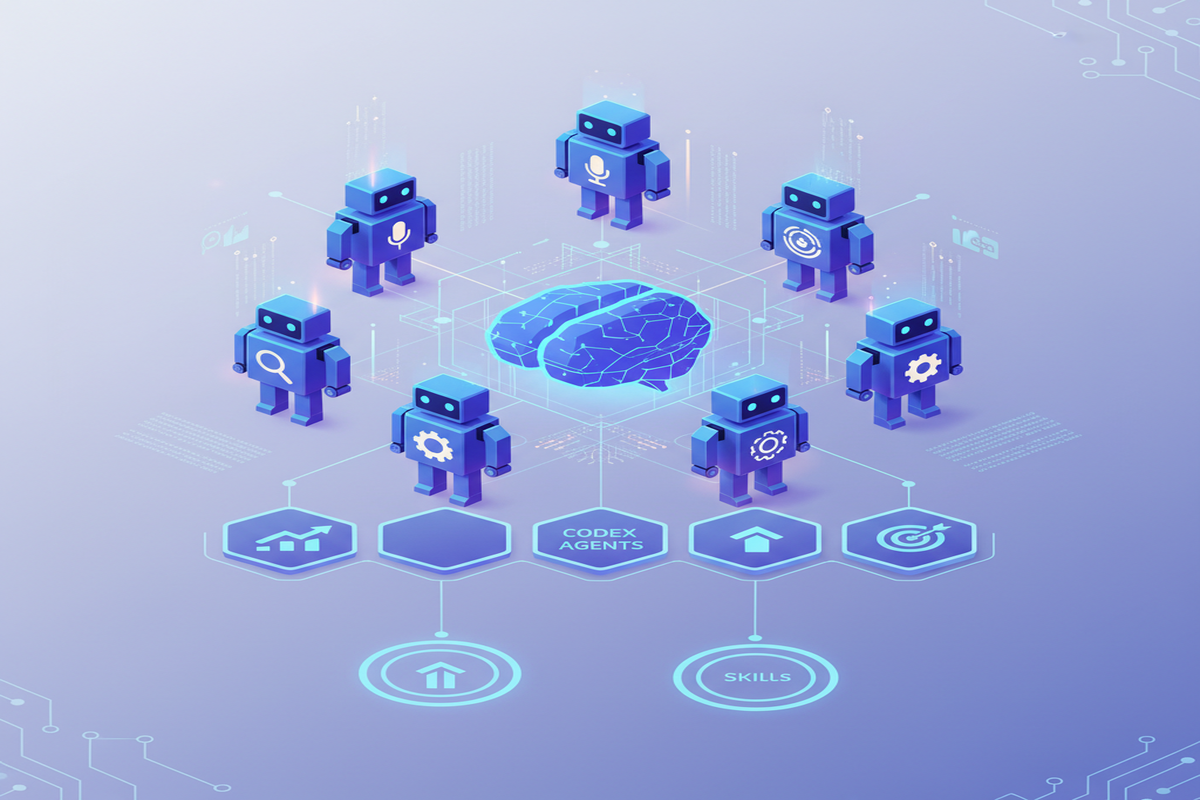
The platform works through a clear layered model. You add skills (specific capabilities like research or writing), connect plugins (integrations with apps like YouTube or your email platform), and deploy agents that coordinate everything into a complete workflow. Each layer builds on the last.
You’re not just automating tasks. You’re building infrastructure.
Key Takeaway: Codex is a unified AI workspace that automates full marketing workflows using agents, skills, and plugins—directly targeting the 60%+ of marketing time lost to repetitive execution work.
The Core Architecture: Skills, Plugins, and Agents
Codex runs on three interdependent layers: skills define what agents can do, plugins connect them to your existing tools, and agents coordinate the full sequence. Understanding this architecture separates power users from casual experimenters.
Skills: Your Agents’ Job Descriptions
Skills are modular capabilities you assign to agents. A skill might be “analyze a YouTube video,” “write a blog post,” or “generate a social caption.” Think of skills like roles on a team. Each one defines a specific area of expertise.
Codex offers a pre-built skill library, but custom skills are where the real power lives. You can encode your exact brand voice, content format, and editorial standards directly into the skill. Your agent won’t drift. It follows your rules every single time.
Plugins: Your Integration Layer
Plugins connect Codex to the platforms you already use—YouTube, Readwise, your CMS, email clients, and social media channels. This is where your agents stop generating text in a vacuum and start operating inside your actual business. They pull live data, sync with your workflow, and push output to the right place.
Agents: The Orchestrators
Agents are the brains. They take a goal—like “publish three content pieces this week based on trending topics”—and coordinate every skill and plugin needed to execute it. According to McKinsey’s 2024 AI Report, companies using multi-agent AI workflows report a 30–45% reduction in time-to-publish for content operations.
That’s not incremental improvement. That’s a structural advantage.
Key Takeaway: The three-layer model—skills, plugins, agents—is the foundation of every Codex workflow. Master it and you control the entire system.
How to Build Your AI Marketing Team in Codex
Building your AI marketing team follows a clear sequence: define your roles, assign skills, connect plugins, then deploy agents. Here’s how each layer maps to a real marketing function.
The Research Layer: YouTube Researcher and Readwise
Every strong marketing strategy starts with research. In Codex, two integrations handle this: the YouTube Researcher skill and Readwise.
The YouTube Researcher skill lets your agent analyze videos in your niche. It extracts themes, spots high-performing content formats, and surfaces data-backed insights your own content should address. You’re not guessing what your audience wants. You’re reading the evidence from what they already watch and engage with.
Readwise works differently. It syncs your personal highlights—from books, articles, newsletters, and podcasts—into a live ideas database your agents can access. When generating content, your agent pulls from what you actually find valuable. That means your output has intellectual depth, not just generic information scraped from the internet.
Together, these tools give your research layer both external market intelligence and internal perspective. That combination is something most human marketing teams struggle to maintain consistently at any pace.
The Content Layer: Writing, Scheduling, and Publishing
Once research is done, your content agent takes over. It uses insights from the research layer to draft blog posts, social captions, email sequences, and more. You set the format, tone, and length upfront. The agent follows your rules on every run.
Publishing agents then push content to your CMS, email platform, and social channels on the schedule you define. According to Sprout Social’s 2024 Index, brands that publish consistently see 67% more engagement than those that publish sporadically. Codex removes the friction that kills consistency in the first place.
Key Takeaway: Stack a research layer (YouTube Researcher + Readwise) with a content layer (writing + publishing agents) and you’ve built a content machine that runs without you in the execution seat.
Advanced Visual Content: Remotion and Hyperframes
Text output is just the start. Codex also supports advanced visual production through Remotion and Hyperframes—two integrations that give your agent stack serious video and image generation capability.
Remotion: Programmatic Video at Scale
Remotion lets you build videos using code. It treats video as a React component, so you can automate entire formats—short-form clips, data visualizations, branded intros—without touching a video editor. Your Codex agents can trigger Remotion workflows to produce video content at volume.
This matters because video demand isn’t slowing down. Cisco’s Visual Networking Index projects that video will account for 82% of all internet traffic globally as the channel matures. If your marketing operation can’t keep up with that output, Remotion-powered agents fill the gap fast.
Hyperframes: On-Brand Visual Assets Without a Designer
Hyperframes brings image generation and visual asset creation directly into your Codex pipeline. Instead of waiting on a designer for thumbnails or social graphics, your agent generates them within the same automated workflow.
Combined with Remotion, Hyperframes gives your AI marketing team a full creative output capability. You’re no longer limited to text automation. You’re running a genuine visual production operation—on autopilot.
Key Takeaway: Remotion handles programmatic video and Hyperframes covers visual assets—giving your agent stack a complete creative output layer beyond text alone.
Vibe-Coding Mini Apps: Where Humans and Agents Collaborate
One of Codex’s most forward-thinking features is the concept of “vibe-coding mini apps.” These are lightweight, purpose-built tools that both you and your agents can operate together to collaborate on media generation.
Here’s what it looks like in practice. You build a mini app that takes a topic, pulls YouTube research, generates a script, and produces a short video—all through a simple interface. You run it manually when you want direct creative control. Your agent runs it automatically when you’re not around.
This human-agent model is important. It avoids the “full autopilot” trap where AI output gradually loses your voice and brand identity. You stay in the loop where creative judgment matters. The agent handles execution everywhere else.
Research from MIT’s Sloan School supports this approach. Their 2023 study found that human-AI collaboration in creative tasks produces output rated 40% higher in quality than either humans or AI working alone. The hybrid model isn’t a compromise. It’s the optimal configuration.
Key Takeaway: Vibe-coding mini apps let you build shared tools that both you and your agents can run—keeping your creative voice intact while maximizing automation across the workflow.
Running Repeatable Business Automations at Scale
The real payoff of Codex is repeatability. Build a workflow once and run it indefinitely with zero extra effort. Your AI marketing team doesn’t get tired, doesn’t miss deadlines, and doesn’t forget your brand guidelines on a Friday afternoon.
Here’s what a fully automated Codex marketing stack looks like in a real content week:
- Monday: Research agent pulls trending topics from YouTube and flags top-performing formats in your niche.
- Tuesday: Content agent drafts three blog posts and five social captions based on research output.
- Wednesday: Visual agent generates thumbnails and branded graphics via Hyperframes.
- Thursday: Publishing agent schedules all content across your CMS and social platforms.
- Friday: Email agent sends a curated weekly newsletter to your subscriber list.
That’s a complete content week—handled entirely by your agents. Your job is to review, approve, and refine the system over time. You’re not doing the work. You’re running the operation.
This transforms your computer into what Codex calls a “prosumer workspace”—a professional-grade production environment that previously required a full agency. According to Gartner’s 2025 Digital Worker Experience Survey, 80% of knowledge workers will interact with AI tools daily within the next few years. The professionals building systems now will lead those who scramble to keep up later.
Key Takeaway: A fully stacked Codex workflow can run an entire content week—research, writing, visuals, scheduling, and email—without you doing any of the execution. You review and approve. Agents do the rest.
Frequently Asked Questions About Building an AI Marketing Team
Do I need coding skills to use Codex?
No. Codex’s core features—agents, skills, and plugins—work through a visual interface. Vibe-coding mini apps require basic familiarity with prompting and simple app logic, but not traditional programming. Most workflows are set up through configuration, not code.
Can Codex fully replace a human marketing team?
For execution tasks, largely yes. Codex agents handle research, writing, scheduling, visual generation, and email management reliably. Where humans still add real value is in strategic direction, brand judgment, and relationship-driven decisions. The best setup is human oversight paired with AI execution—not one or the other.
How is Codex different from using ChatGPT or Claude on their own?
ChatGPT and Claude are AI models. Codex is an orchestration platform. It connects AI models with live data, real tools, and automated multi-step workflows. You’re not just chatting with an AI. You’re building a system that acts autonomously across multiple platforms simultaneously.
What’s the smartest way to start building in Codex?
Start with one workflow. Pick your biggest content bottleneck—blog research, social scheduling, email drafts—and build a single agent to solve it. Get that working well before adding more layers. Stacks build fastest and most reliably when you go one workflow at a time.
Conclusion: Your AI Marketing Team Is a Stack, Not a Single Tool
Building an AI marketing team with Codex isn’t about adding one more app to your workflow. It’s about rethinking how marketing work gets done at a fundamental level. You shift from being the person doing the work to being the architect of the system that does it.
The stack is clear. Research with YouTube Researcher and Readwise. Write and publish with content agents. Produce visuals with Remotion and Hyperframes. Deliver across every channel on autopilot. Each layer strengthens the one beneath it.
Start simple. Build one workflow. Watch it run. Then add the next layer. That’s how great stacks are built—not all at once, but one reliable piece at a time.
The professionals who build these systems now won’t just save time. They’ll outproduce their competition at a fraction of the cost. Your AI marketing team is ready to be built. Go stack it.
You might also enjoy: OpenAI Finally Delivered: The AI Productivity Tools Changing How You Work
You might also enjoy: How Claude Code Recovered $400,000 in Lost Crypto — And What It Means for Your Productivity Stack