
What’s Next for the U.S. Economy: How to Protect and Grow Your Wealth in 2026
The U.S. economy outlook in 2026 is a study in contradictions. Interest rates are easing off their multi-decade highs, yet inflation refuses to fully surrender. Job numbers look solid on the surface, but real wages are losing ground to compounding cost-of-living pressures. Aggressive tariff policies are reshaping global supply chains in real time. If you’re an ambitious professional trying to build wealth in this environment, passive observation is not a strategy. This post breaks down exactly what is happening, what is coming next, and the concrete moves you need to make to protect and grow your financial stack right now.
The Current U.S. Economy Outlook: Where Things Actually Stand
The U.S. economy is in a critical transitional phase. After the most aggressive Federal Reserve rate-hiking cycle in four decades, growth has decelerated but not collapsed. GDP growth has settled near 1.5–2% annually, inflation remains above the Fed’s 2% target, and consumers are increasingly stretched by compounding cost-of-living pressures that savings simply cannot absorb.
U.S. GDP growth decelerated to approximately 1.6% in 2025, down from the post-pandemic high of 5.7% in 2021, according to Bureau of Economic Analysis data. That slowdown is not a crash—but it is a sustained yellow warning light that demands a strategic response from anyone building wealth.
Unemployment has drifted upward from its historic lows, hovering near 4.5–4.8% as of early 2026. Meanwhile, the personal savings rate—which surged during pandemic-era stimulus—has collapsed back below 4%, meaning most American households carry minimal financial runway. Consumer credit card debt has surpassed $1.2 trillion, a record high, signaling that millions of families are actively borrowing to maintain their standard of living rather than building assets.
The real macro threat here is not a single dramatic crash. It is the slow, grinding erosion of purchasing power happening in parallel with rising household debt loads and stagnating real wage growth. This is the economic environment you are building wealth inside of right now.
Key Takeaway: The U.S. economy is experiencing slow-burn deceleration, not freefall. The cumulative pressure on household finances is real and accelerating. Understanding this distinction is the difference between panic-selling at the bottom and positioning strategically for what comes next.
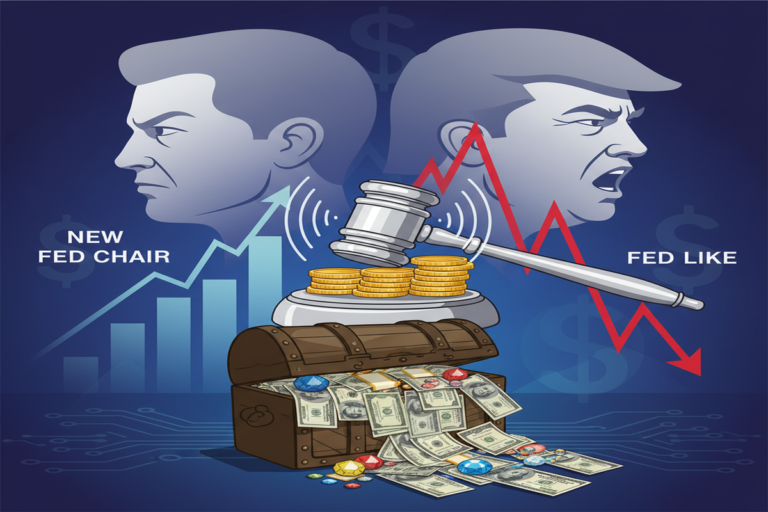
The Federal Reserve’s Next Move: Is Quantitative Easing Coming Back?
The Federal Reserve has begun cutting interest rates, but the more significant question is what happens when rate cuts alone are insufficient. The historical pattern is clear: when energy costs spike, credit markets seize, or a systemic financial shock emerges, the Fed’s default response is to expand its balance sheet—a process known as quantitative easing, or QE. That playbook is almost certainly on the table again.
After peaking near $9 trillion during the post-COVID era, the Fed’s balance sheet was reduced to approximately $6.7 trillion through quantitative tightening (QT). That is a significant reduction, but the Fed has never completed a full normalization cycle without encountering a crisis that forced it to reverse course. The 2019 repo market chaos is one example. The 2020 pandemic response is another. The pattern is consistent.
The mechanism of any future stimulus will carry enormous implications for your wealth. If the Fed re-enters QE by purchasing U.S. Treasuries and mortgage-backed securities en masse, it injects new liquidity into financial markets—historically a powerful tailwind for equities and real estate. But it also devalues the purchasing power of every dollar sitting in a low-yield savings account. In short, money printing is inflationary by design, and the specific assets you hold during that cycle determine whether your net worth expands or quietly erodes.
The critical insight for wealth builders: QE does not lift all boats equally. It disproportionately benefits holders of hard assets, equities, and real estate—and punishes those who remain in cash or fixed-rate instruments with sub-inflation yields.
Key Takeaway: The Federal Reserve’s most probable response to a significant economic shock is renewed money supply expansion. Position your wealth stack to benefit from liquidity injections—not to be quietly destroyed by them.
Inflation’s Second Act: Why the Price Problem Is Not Over
Inflation did not disappear—it decelerated. Core PCE inflation, the Fed’s preferred measurement, remains persistently above its 2% target. New structural pressures from tariffs, energy market volatility, and a declining dollar are layering additional cost increases onto an economy where consumers are already financially stretched.
The Consumer Price Index (CPI) hovered around 3.2–3.5% through 2025, stubbornly elevated despite 18 months of restrictive monetary policy. The key driver now is not monetary stimulus from 2020—it is structural cost inflation baked into supply chains by tariff policy and geopolitical disruption. When import costs rise on manufactured goods, electronics, and industrial materials, those costs flow downstream to consumers with minimal friction.
Energy costs represent a particularly volatile wildcard. Oil prices are acutely sensitive to geopolitical instability in the Middle East, OPEC+ production decisions, and domestic U.S. energy policy shifts. A significant energy price spike—which historically arrives with little warning—can re-accelerate inflation across virtually every category of consumer spending simultaneously.
For wealth builders, the takeaway is tactical: every dollar left in a high-yield savings account earning 4.5% is barely breaking even against real inflation when you factor in taxes on interest income. Your money needs to work harder and smarter than parking it in cash.
Key Takeaway: Inflation is not a solved problem—it is an intermission. Tariffs, energy volatility, and continued money supply expansion are structural forces that keep prices elevated. Your investment strategy must outpace inflation, not just match it.
The Job Market Reality Check: What’s Changing for Your Income
The U.S. labor market remains relatively resilient by headline metrics, but the composition of job growth is shifting in ways that carry serious long-term income implications. AI-driven automation is compressing salaries in white-collar knowledge work, while skilled trade roles face acute shortages. Your income strategy must adapt to this new topology.
According to McKinsey Global Institute research, approximately 30% of hours worked across the U.S. economy could be automated by 2030 using currently available technology. That automation wave is not theoretical—it is actively being deployed across legal services, financial analysis, marketing, software development, and customer service. The industries that millennials and Gen Z professionals entered expecting lifetime career progression are being restructured faster than most people realize.
At the same time, the manufacturing reshoring trend—driven by tariff incentives and national security concerns around semiconductor supply chains—is creating genuine wage growth in skilled trades and manufacturing operations. Electricians, HVAC technicians, and industrial welders are commanding salaries that now rival many four-year degree professions.
The actionable implication for your income stack is diversification. A single W-2 salary, regardless of how stable it appears today, is a concentration risk in an economy undergoing structural disruption. Building a side income layer through freelancing, digital products, content, or consulting is no longer optional optimization—it is fundamental risk management.
Key Takeaway: The job market is bifurcating between roles AI can replace and roles it cannot. Diversifying your income sources is the single highest-leverage financial decision you can make in 2026.
How to Build a Recession-Proof Wealth Stack Right Now
In an uncertain economic environment, the priority order for wealth building remains unchanged: eliminate high-interest debt, build a cash reserve that covers 3–6 months of essential expenses, then aggressively deploy capital into diversified assets that outpace inflation. Complexity is the enemy of consistency. Simplify your stack and execute relentlessly.
Here is the layered approach, built for this specific economic environment:
Layer 1: Eliminate Debt That Costs More Than Inflation
Credit card debt averaging 22–24% APR is the single most destructive force on your balance sheet. Every dollar deployed against high-interest consumer debt generates a guaranteed, risk-free 22% return. No investment consistently beats that. Use the avalanche method—highest interest rate first—to systematically eliminate this liability before building above it.
Layer 2: Build a Proper Emergency Fund—Then Stop There
A 3–6 month emergency fund held in a high-yield savings account (HYSA) or Treasury-backed money market fund is your financial shock absorber. In a volatile economy, this buffer is what prevents you from liquidating investments at the worst possible moment. Park it. Leave it. Do not optimize it into oblivion trying to earn an extra 0.3%.
Layer 3: Invest Consistently, Regardless of Market Noise
Dollar-cost averaging (DCA) into low-cost index funds—specifically broad market funds tracking the S&P 500 and total market indexes—remains the empirically validated wealth-building mechanism for most investors. Vanguard research consistently shows that investors who automate contributions and avoid market-timing outperform active traders by 1.5–2% annually over 10-year periods. That compounding gap is wealth-defining.
Layer 4: Consider Hard Assets as Inflation Hedges
Real estate, I-Bonds (when rates are attractive), and commodities exposure through diversified ETFs serve as partial inflation hedges within a broader portfolio. These are not primary wealth engines—they are portfolio stabilizers that protect purchasing power when QE re-enters the picture.
Key Takeaway: The recession-proof wealth stack is not glamorous. It is systematic, boring, and exceptionally effective. Debt elimination, emergency reserves, automated index investing, and hard asset hedges form the four-layer foundation your financial future is built on.
Investment Strategies Calibrated for the 2026 U.S. Economy Outlook
In a slowing-growth, elevated-inflation environment where monetary easing is on the horizon, specific asset classes historically outperform. Equities, real estate, and inflation-protected securities offer the most favorable risk-adjusted positioning relative to cash equivalents and long-duration bonds in the current cycle.
When the Fed begins a rate-cutting cycle—which is underway—equities have historically delivered strong forward returns. An analysis of every Fed cutting cycle since 1980 shows the S&P 500 averaged approximately 14% returns in the 12 months following the first rate cut, provided a recession was avoided. That is not a guarantee, but it is a meaningful base rate for calibrating your equity allocation.
Within equities, sectors with pricing power—energy, industrials tied to reshoring, healthcare, and consumer staples—tend to outperform in inflationary environments. Growth-heavy tech, while dominant in recent years, is more sensitive to rate movements and valuation compression risks.
Real estate investment trusts (REITs) deserve reconsideration as rates decline. REITs were brutally punished during the rate-hiking cycle, but declining rates historically serve as a strong tailwind for REIT valuations and dividend yield attractiveness. Residential REITs and industrial REITs tied to e-commerce logistics are particularly worth examining.
Key Takeaway: The 2026 U.S. economy outlook favors equities and real assets over cash and long-duration bonds. Position your portfolio to capture the tailwinds of monetary easing while maintaining a defensive hedge against inflation’s persistence.
Frequently Asked Questions About the U.S. Economy in 2026
Is the U.S. headed for a recession in 2026?
A full technical recession—defined as two consecutive quarters of negative GDP growth—is not the consensus forecast for 2026, but the probability is meaningfully elevated compared to a normalized economic environment. GDP growth near 1.5% leaves virtually no margin for external shocks. Inverted yield curves, tightening credit conditions, and declining consumer confidence are the three most reliable leading indicators to monitor in real time.
Should I stop investing if I think a recession is coming?
No. Attempting to time the market based on macroeconomic predictions has an empirically poor track record, even among professional fund managers. Missing just the 10 best trading days in the S&P 500 over a 20-year period cuts your total return roughly in half. The evidence overwhelmingly supports continuing systematic, automated contributions regardless of economic headlines.
How does quantitative easing affect my investments?
QE expands the money supply by having the Federal Reserve purchase assets, injecting liquidity into the financial system. Historically, this has been bullish for equities and real estate, and bearish for the purchasing power of cash. If QE returns in force, investors holding hard assets and diversified equities are better positioned than those sitting in cash or long-duration fixed income.
What is the single most important financial move to make right now?
Eliminate high-interest consumer debt immediately and increase your income streams beyond a single salary. These two actions have the highest combined return on effort of any financial decision you can make in a volatile, inflationary economy—before any investment strategy is relevant.
Conclusion: Stack Your Wealth Deliberately Before the Next Cycle Hits
The U.S. economy outlook for the remainder of 2026 and beyond is not one of doom—it is one of structural transition. The rules of the previous economic era are being rewritten by monetary policy pivots, automation-driven labor disruption, geopolitical trade realignment, and the looming return of liquidity expansion. Each of these forces creates both risk and opportunity.
Your wealth stack is either positioned to capture that opportunity or it is being quietly eroded by inaction. The playbook is not complicated: eliminate debt that bleeds you, build a cash buffer that protects you, invest systematically in diversified assets that grow you, and diversify your income so no single employer or client controls your financial future.
The ambitious professionals who come out of this economic transition ahead will not be the ones who predicted every twist correctly—they will be the ones who built systems that performed reliably through uncertainty. That is the entire point of building a stack. Start layering now.
Disclaimer: This content is for informational purposes only and does not constitute financial, legal, or investment advice. Always conduct your own research and consult with a qualified financial advisor before making any financial decisions.
You might also enjoy: My Stock Market Prediction Was Wrong — Here’s How I’m Rebuilding My Portfolio
You might also enjoy: I F*cked Up My Stock Market Prediction: What I’m Doing Differently Now
You might also enjoy: Togi Owes $2M In Taxes: What Every High Earner Must Know About Sudden Income Tax Liability