Claude Opus 4.7 Is Here — But Does It Actually Belong in Your Productivity Stack?
The AI model wars are relentless. Claude Opus 4.7, Anthropic’s latest flagship release, hit the market with serious buzz — and immediately split the developer community right down the middle. Some power users are calling it the most capable reasoning model available for autonomous workflows. Others are filing bug reports over hallucinations and broken system prompt behavior that make it unreliable in production pipelines. So which side is right? This post cuts through the noise. We’ll break down what Claude Opus 4.7 actually does well, where it stumbles, and — more critically — why the entire debate over this single model is a distraction from a much larger architectural shift that will fundamentally change how you build and use every productivity system you own.
What Is Claude Opus 4.7 and Why Should Productivity-Focused Professionals Care?
Claude Opus 4.7 is Anthropic’s most advanced model release to date, purpose-built for complex, long-horizon tasks that go far beyond simple question-answering. It is designed for agents, not just chat — and that distinction carries enormous practical implications for how ambitious professionals should think about integrating it into their workflows.
For builders running multi-step automation pipelines, coding agents, or AI-assisted research systems, the Opus tier has always represented Anthropic’s highest-capability offering. The 4.7 iteration pushes those boundaries further with improved reasoning coherence, extended context handling, and enhanced instruction-following in complex system prompt environments. According to Anthropic’s published evaluations, the Opus 4 series demonstrates measurable improvements over its predecessors on software engineering benchmarks like SWE-bench, where frontier models now routinely resolve over 50% of real-world GitHub issues autonomously — a capability threshold that opens up entirely new automation use cases for developers and non-developers alike.
The reason this matters for your stack specifically: if you are still using AI as a one-shot chatbot — asking questions, getting answers, moving on — you are massively underutilizing what these systems can do. Claude Opus 4.7 is optimized for agentic workflows: multi-step reasoning chains, autonomous decision-making loops, and API-driven task execution that runs without human hand-holding at every step. That is a qualitatively different use case, and it demands a qualitatively different integration strategy.
Key Takeaway: Claude Opus 4.7 is not a chatbot upgrade — it is an infrastructure layer designed for autonomous, multi-step agent workflows. Professionals who treat it as a simple chat tool will miss its highest-value applications entirely.
Where Claude Opus 4.7 Genuinely Excels: Front-End Design and Long-Horizon Reasoning
Claude Opus 4.7’s two standout capabilities are front-end code generation and long-horizon reasoning coherence. Both are legitimately impressive at scale and represent a meaningful productivity multiplier for builders and knowledge workers operating on complex, multi-stage projects.
Front-End Design and Code Generation
When tasked with generating functional UI components, structured HTML/CSS layouts, or full React component trees from natural language descriptions, the model produces clean, production-adjacent code with a level of contextual awareness that competing models frequently miss. It doesn’t just write code that technically runs — it considers design intent, accessibility patterns, and component hierarchy in ways that reflect a genuinely deeper understanding of front-end architecture.
For solo founders, indie developers, or productivity builders without dedicated design resources, this capability alone can compress weeks of iteration into hours. A 2024 GitHub developer productivity study found that engineers using AI-assisted coding tools reported a 55% increase in coding speed for boilerplate-heavy tasks — and design-aware outputs like those from the Opus tier push that multiplier even higher for UI-intensive projects.
Long-Horizon Reasoning and Multi-Step Task Completion
Where most models break down on complex, multi-stage tasks — losing thread, contradicting earlier outputs, or failing to maintain context across long instruction chains — this model demonstrates significantly more stable performance. It can hold a goal state in mind across dozens of reasoning steps, making it exceptionally well-suited for research synthesis, strategic planning frameworks, and autonomous coding agents that need to debug, refactor, and test across extended sessions.
This is not a marginal improvement worth dismissing. Long-horizon coherence is the single biggest gap between AI as a party trick and AI as a genuine leverage multiplier for ambitious professionals. Models that lose the thread halfway through a complex task create more rework than they save — models that maintain it compound your output exponentially.
Key Takeaway: The model’s two highest-value capabilities — design-aware front-end code generation and coherent long-horizon reasoning — make it a serious tool for builders, not just curious users. These are the use cases worth building your integration strategy around.
The Real Weaknesses: System Prompt Issues and Hallucinations Under Pressure
No frontier model is flawless, and two specific failure modes have been consistently surfaced by early adopters: system prompt drift in complex agentic setups and overconfident hallucinations on low-context factual queries. Both are manageable — but only if you know they exist before you build.
System Prompt Inconsistencies in Multi-Agent Setups
Multiple developers have reported that the model can exhibit inconsistent behavior when operating under complex system prompts — particularly in multi-agent orchestration setups where one AI instance is directing another. The model occasionally diverges from its instructed persona or operational constraints as context windows fill with long conversation histories. This is a non-trivial problem for anyone building production-grade agent systems where predictability is the entire value proposition.
The practical mitigation strategy: keep system prompts tightly scoped and explicitly structured, implement re-anchoring messages at regular intervals in long agentic loops, and always design human-in-the-loop checkpoints for high-stakes decision nodes until behavior stabilizes across model updates.
Hallucinations on Low-Context Factual Queries
Counterintuitively, the model can be more prone to confident-sounding hallucinations on low-context factual questions than on deeply reasoned, document-grounded tasks. When it lacks sufficient context to ground its response, it sometimes fills the gap with plausible-sounding fabrications rather than expressing appropriate uncertainty. According to a 2025 AI reliability study by Stanford’s Human-Centered AI Institute, hallucination rates across frontier LLMs remain above 15% on open-domain factual queries — a problem the industry has not solved regardless of model tier.
The solution is architectural: always provide document-grounded context for factual tasks, implement retrieval-augmented generation (RAG) pipelines when accuracy is non-negotiable, and treat isolated factual claims from any AI model with the same skepticism you would apply to an unverified primary source.
Key Takeaway: System prompt drift and hallucinations on low-context queries are real failure modes that require active architectural mitigation. Neither disqualifies the model for serious use — but both will burn you if you deploy it naively.
The Bigger Picture: The Agent-First Internet Is Already Reshaping Every Tool You Use
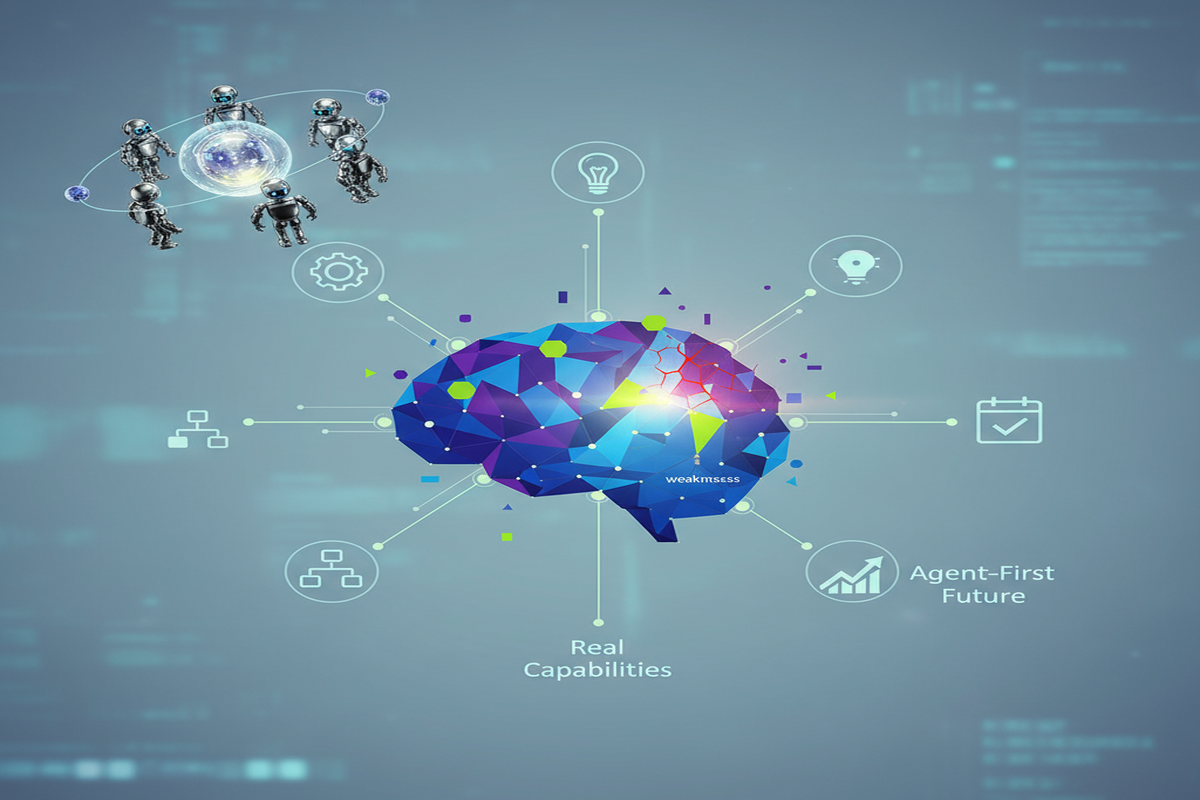
The most important insight getting buried under model benchmarking debates is this: the tech industry is undergoing a fundamental architectural transition toward an agent-first internet — and it will change the design, purpose, and competitive landscape of every productivity tool you currently rely on, regardless of which AI model wins the capability race.
The traditional model of software is: a human opens an application, navigates a UI, and manually executes tasks. The emerging model is: an AI agent queries an API, receives structured data, makes decisions, and executes workflows — with zero human interface required at each step. This is what’s meant by headless software: applications stripped of their graphical front-ends and redesigned from the ground up to serve autonomous AI agents rather than human eyes.
Major platforms are already pivoting hard in this direction. Salesforce has been aggressively building agentic CRM layers that allow AI to manage customer relationships autonomously. Stripe has launched API-first payment infrastructure explicitly designed for AI-driven commerce flows. Anthropic itself is developing the Model Context Protocol (MCP), an open standard that allows AI agents to connect directly with external services, databases, and software systems without bespoke integration work. According to a 2025 Gartner forecast, by 2027, over 25% of enterprise software interactions will be initiated by autonomous AI agents rather than human users — a seismic shift from today’s baseline that most professionals are completely unprepared for.
Key Takeaway: The agent-first internet is not a future concept — it is being actively built right now by Salesforce, Stripe, Anthropic, and dozens of others. Productivity professionals who understand this architectural shift will build dramatically more powerful systems than those who remain focused on UI-centric, human-operated tools.
Headless Software and Agent-to-Agent Communication: The Infrastructure of the AI-Native Future
Headless software and agent-to-agent communication form the two foundational infrastructure layers of the AI-native internet. Understanding how they work — even conceptually — is no longer optional for anyone serious about building a durable, high-leverage productivity stack.
What Headless Software Actually Means for Your Stack
Headless software decouples an application’s back-end logic and data layer from its presentation layer. In traditional software, the UI and the logic are tightly coupled — buttons exist because a human needs to click them. In a headless architecture, those buttons simply don’t exist. An AI agent communicates directly with the underlying system via structured API calls, which is dramatically faster, more scalable, and infinitely more composable.
For your current productivity stack, this means the tools you rely on are being rebuilt around API-first architectures that allow AI agents to trigger actions, retrieve data, and execute workflows without you manually navigating an interface. Notion’s API, Zapier’s automation engine, and platforms like Make.com are early expressions of this trend — but the next generation goes significantly further, enabling agents to operate as full autonomous participants in software ecosystems rather than simple automation triggers.
Agent-to-Agent Communication: The Collective Intelligence Layer
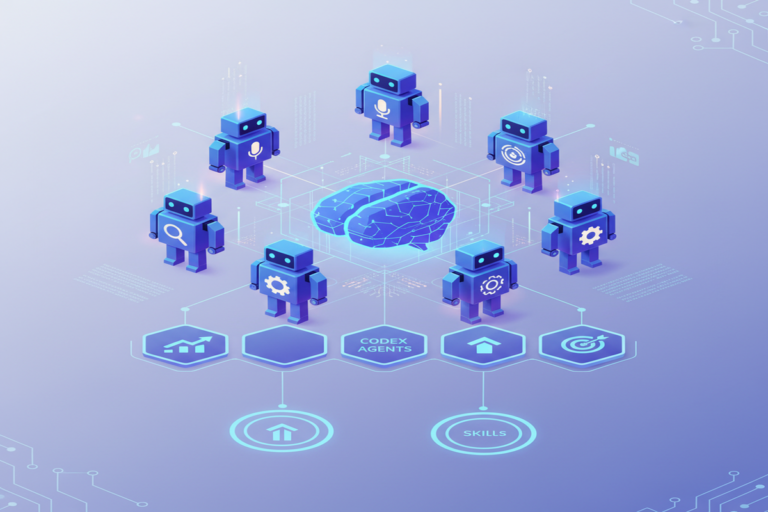
The most compelling emerging concept in this space is agent-to-agent communication: AI systems that can autonomously coordinate, delegate subtasks, and share context with each other to accomplish complex goals at a speed and scale no human team can match. Experimental frameworks already being developed allow individual AI agents to publish their capabilities to shared registries and be dynamically recruited by orchestrating agents to complete specialized sub-tasks — essentially a real-time marketplace for AI capability, operating at machine speed with no overhead.
This paradigm points toward a future where your “productivity tool” is not a single application but a dynamic network of specialized agents assembling and disassembling around your specific goals in real time. The professionals building familiarity with these concepts now will have a compounding advantage over those who discover them two years from now when they are already table stakes.
Key Takeaway: Headless software strips the human interface layer from applications, enabling AI agents to operate through APIs directly. Agent-to-agent communication extends this further, allowing AI systems to dynamically coordinate on complex tasks — forming the backbone of truly autonomous productivity infrastructure.
How to Build a Future-Proof AI Layer in Your Productivity Stack Right Now
Understanding the trajectory of AI architecture is only valuable if you can act on it today. These four concrete steps will position your productivity stack for the agent-first transition without waiting for the technology to fully mature.
Step 1: Audit Your Current Tools for API Accessibility
Go through every tool in your current stack and identify which ones expose a full API. Notion, Linear, GitHub, Airtable, Slack, and Zapier are your agentic-ready tools. Applications that are UI-only with no API access are dead ends in an agent-first world. Start migrating critical workflows to API-accessible alternatives wherever the switching cost is manageable.
Step 2: Learn the Model Context Protocol (MCP)
Anthropic’s MCP is rapidly becoming the standard protocol for connecting AI models to external services and data sources. Understanding how MCP servers work — even at a conceptual level — puts you ahead of the overwhelming majority of knowledge workers who are still using AI as a glorified search engine. Invest a few focused hours in MCP documentation now; it pays compounding dividends as the ecosystem matures.
Step 3: Build One Real Agentic Workflow This Month
Don’t just read about agents — deploy one. Start with a high-repetition, low-stakes task: automated email triage and draft generation, recurring research synthesis, or scheduled report compilation. Use n8n, Make.com, or a direct API integration with any frontier model. A working, imperfect agent that automates one real task is worth infinitely more than a perfect theoretical understanding of the architecture.
Step 4: Optimize Your Digital Outputs for GEO, Not Just SEO
If you create content, build products, or manage any form of digital presence, start thinking about Generative Engine Optimization (GEO). AI agents — not human eyeballs — are increasingly the primary “readers” of structured data on the internet. Content and data architectures optimized for machine parsing — clear schemas, direct answers, structured metadata — will dramatically outperform human-optimized content in an agent-first discovery environment. According to a 2025 BrightEdge research report, AI-generated search results now influence over 40% of informational queries across major search platforms. This is a present-tense problem, not a future one.
Key Takeaway: Future-proofing your productivity stack means auditing for API accessibility, learning MCP, deploying at least one real agentic workflow, and beginning to optimize your digital outputs for AI consumption — not just human consumption. All four steps are executable today.
Frequently Asked Questions
Is Claude Opus 4.7 better than GPT-4 or Gemini Ultra for agentic workflows?
For long-horizon reasoning coherence and front-end code generation specifically, many developers report that the Opus tier outperforms comparable GPT-4 configurations. However, each model has task-specific strengths, and the right answer for your stack depends entirely on your use case. Benchmark your actual workflows with real tasks rather than relying on general leaderboard comparisons — model performance varies significantly by domain and prompt structure.
How serious are the hallucination and system prompt issues in real production use?
For document-grounded tasks and casual use, hallucination rates are low enough to manage with basic verification habits. For production agentic deployments where the model operates autonomously over long sessions, the system prompt drift issue is more significant and requires explicit architectural mitigations: structured re-anchoring, scoped system prompts, and human checkpoints at high-stakes decision nodes. No frontier model should be deployed in fully autonomous high-stakes workflows without guardrails.
What is headless software and do I actually need to understand it?
Headless software refers to applications designed to be accessed entirely via API, without a graphical user interface, enabling AI agents to interact directly with the system’s underlying logic. If you build digital products, manage technical teams, or plan to leverage AI automation at meaningful scale, yes — understanding headless architecture is increasingly essential. If you are a pure end-user, the relevant skill is simply knowing which of your current tools expose API access and which do not.
Is now the right time to invest in learning AI agent development?
Yes — and the window for early-mover advantage is closing faster than most people realize. According to the 2025 World Economic Forum Future of Jobs report, AI and automation literacy ranks among the top five skills in highest demand by employers over the next five years. Building genuine hands-on experience with agent frameworks now puts you in the top percentile of practitioners before the mainstream catches up and the skill becomes table stakes rather than a differentiator.
Conclusion: Stop Asking If the Model Is Good Enough — Start Building What’s Next
The debate over whether any AI model “sucks” fundamentally misframes the question. Is this a powerful, genuinely impressive reasoning engine with documented weaknesses in specific deployment contexts? Yes. Is the far more important question whether you are building your productivity infrastructure to operate in an agent-first, API-driven, headless software world? Absolutely.
The professionals who will extract the most asymmetric value from the current AI moment are not the ones obsessing over model leaderboards. They are the ones building systems: auditing their stacks for API access, learning how to orchestrate agents, deploying real automation workflows today, and positioning their digital outputs for a world where AI agents are the primary consumers of information on the internet.
The stack does not build itself. Add the agentic layer. Start imperfectly. Start now.
You might also enjoy: OpenAI’s New Super App: A Hands-On Breakdown for Power Users
You might also enjoy: The $800 Vibe Coding Mistake: What AI Developers Get Wrong About Oversight
You might also enjoy: My Honest Thoughts on DeepSeek: Is It Worth Your Time?